Recent Podcast Appearances
Political Demons and How We Deal With Them w/ Michael Heyes

Special Guest:
Michael Heyes, Author of Devils of Democracy: America's Love Affair with Political Demons from the Revolution to Today & Associate Professor and Chair of the Department of Religion at Lycoming College
Question of the Week:
How do theologies based on fear shape the way Christians understand power, enemies, and democracy? Why are fear and demonization such persuasive and powerful tools in religion and politics?


How America Turns Political Opponents Into Demons | Michael E. Heyes

What happens when your political opponent becomes more than wrong and starts to look like an agent of evil? Religion scholar Michael E. Heyes joins Faithful Politics to trace America's long history of mixing demons with politics. From spiritualists, abolition and Abraham Lincoln during the Civil War era to Billy Graham, the Satanic Panic, modern spiritual warfare, C. Peter Wagner and the New Apostolic Reformation, Heyes shows how demonic language has repeatedly been used to explain political conflict and social change. We also explore why conspiracy theories thrive when complicated problems are reduced to cosmic battles, how suffering can make people more susceptible to othering, and what happens when Christians begin seeing themselves as soldiers fighting human opponents on God's behalf. The conversation ultimately raises a larger question: How do we recognize genuine evil without turning our neighbors, political opponents and fellow citizens into monsters?

Michael E. Heyes: In Conversation… with Frank Schaeffer
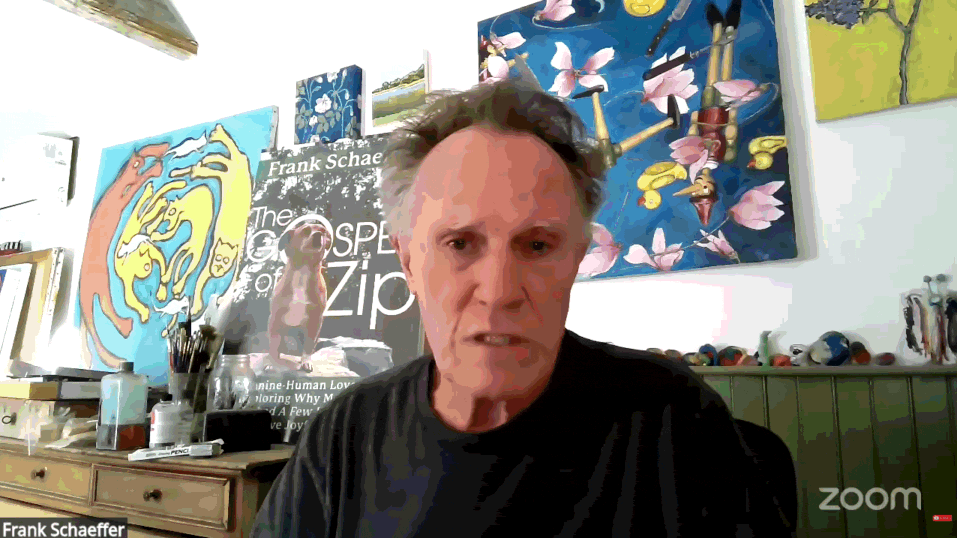
Frank Schaeffer In Conversation with Michael E. Heyes, exploring his life and work and the themes of his book, “Devils of Democracy: America's Love Affair with Political Demons from the Revolution to Today.”

Demons, Podcasts, and Politics:
Lance Wallnau's Ideas of Dominion and Spiritual Warfare
In the fourth episode of our series on Spiritual Warfare, we had the pleasure of speaking with Dr. Michael E. Heyes, a leading specialist on the “demonic” at Lycoming College in Williamsport, PA. Dr. Heyes’ new book, Devils of Democracy: America's Love Affair with Political Demons from the Revolution to Today, will be published on September 15. Check out this episode if you’re interested in how demons and politics sometimes intertwine!

Recent Articles
Writer's Digest: "5 Things Writers Should Know About the Language of Demons, Evil, and ‘The Enemy’ in Politics"
Author and professor Michael E. Heyes shares five things writers should know about the language of demons, evil, and “the enemy” in politics.
The Conversation: "The ‘Courage Tour’ is attempting to get Christians to vote for Trump − and focused on defeating ‘demons’"
The Courage Tour is encouraging conservative Christians to evangelize for Trump in 2024. It does this through a focus on defeating demons and guarding against the end times.
Religion Dispatches: "The 'Jezebel Spirit' Isn't (Just) Bible-Based Misogyny, it's a Literal Demon — So What Happens When They 'Stop Tolerating' It?"
The Jezebel Spirit has been used by a variety of figures in the 2016–2024 presidential election cycles, but the new focus on emasculation might bring a new, violent trend to its use.
Religion Dispatches: "A Match Made in Hell: Demons Have Become a Serious Force in US Politics — But We've Seen This Show Before"
It might seem to many that the new focus on demons in politics is a never-before-seen trend. In fact, it's just a return to American politics as usual.
Open Access Journal Articles
Scholarship on monstrosity has often focused on beings that produce fear, terror, anxiety, and other forms of unease. However, the semantic range of the term “monster” includes beings who evoke a wide range of emotions. I argue that scholars have largely displaced first-person accounts of the monstrous and those accounts that do not rely on horror or anxiety, and I propose a three-category system to correct this displacement, drawing on Derrida’s notion of the domestication of the monster and Žižek’s concept of the “fantasy screen.”
Francis Lawrence’s I Am Legend is a complex intertext of Matheson’s novel of the same name and its two previous film adaptations. While the film attempts to depict racism as monstrous, the frequent invocation of 9/11 imagery and Christian symbolism throughout the film recodes the vampiric dark-seekers as radical Islamic terrorists. This serves to further enshrine an us/Christians vs. them/Muslim dichotomy present in post-9/11 America, a dichotomy that the film presents as “curable” through the spread of Christianity and the fall of Islam.